
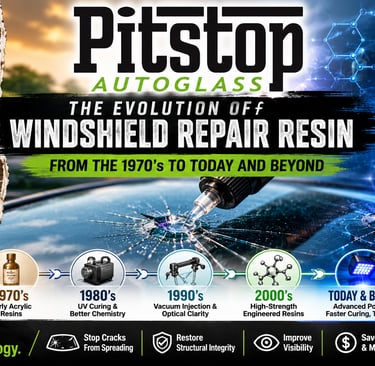
The Evolution of Windshield Repair Resin: From the 1970s to Today
How Modern Windshield Repair Became a Science
SAN DIEGO WINDSHIELD REPAIRWINDSHIELD REPAIR STANDARDSWINDSHIELD REPAIR CRITICAL EDUCATIONPITSTOP AUTOGLASS WINDSHIELD REPAIR SCIENCE BLOG
Gillian R - Pitstop Autoglass + Windshield Repair Sevice Center
6/14/20266 min read
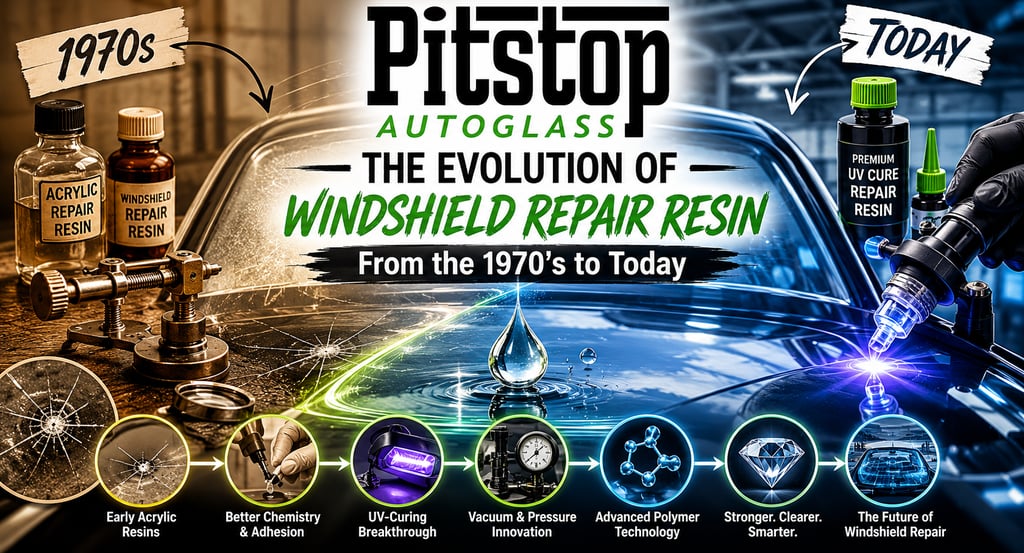
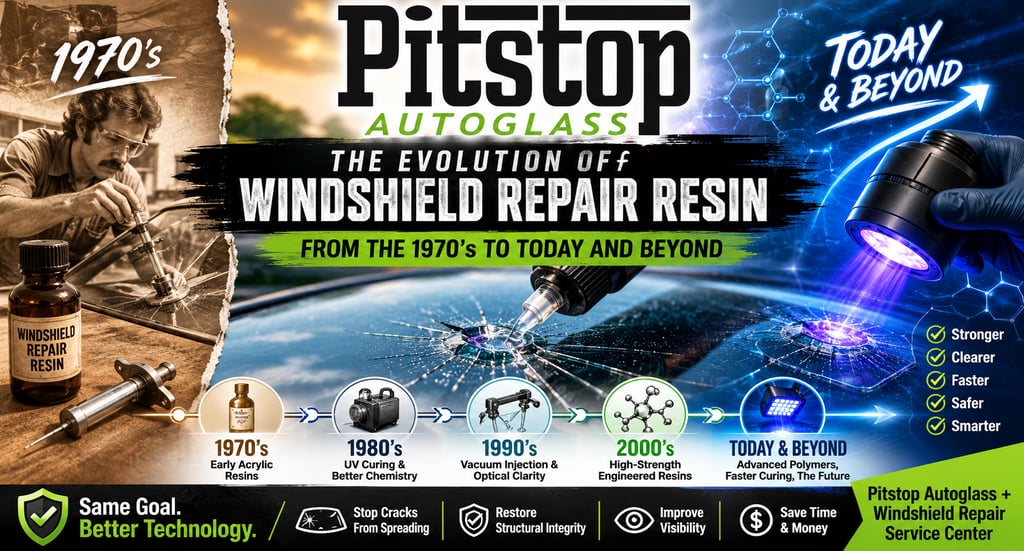
Windshield repair has changed dramatically over the last 50 years. What began as a simple attempt to stop cracks from spreading has evolved into a highly technical process involving engineered polymers, optical science, UV curing technology, and structural performance testing.
Today, modern windshield repair resin can restore clarity, improve structural integrity, and help preserve the original factory seal of the windshield. At Pitstop Autoglass + Windshield Repair Service Center, we have seen firsthand how advanced repair systems now outperform the early methods used decades ago.
Understanding the history of windshield repair resin helps drivers appreciate why professional repair matters and why modern repairs are more reliable than ever before.
The Early Days of Windshield Repair in the 1970s
Before the 1970s, damaged windshields were almost always replaced. There were very few reliable repair systems available, and most technicians believed cracks and chips could not be stabilized safely.
That changed as inventors and glass technicians began experimenting with clear liquid polymers that could fill rock chips and prevent further damage.
The first windshield repair resins were basic acrylic compounds. These early materials were thin, weak, and often yellowed over time. They improved appearance slightly, but they lacked the strength and optical quality needed for long-term durability.
Several major problems existed with early repair resin technology:
Poor adhesion to glass
Air bubbles trapped inside breaks
Yellowing from sunlight exposure
Weak tensile strength
Slow curing times
Limited penetration into tight cracks
Still, these first systems proved one important fact: windshield damage could sometimes be repaired instead of replaced.
This discovery laid the foundation for the modern windshield repair industry.
The 1980s: The Birth of Professional Windshield Repair
During the 1980s, windshield repair became a legitimate automotive service industry. Resin manufacturers started developing specialized formulations designed specifically for laminated automotive glass.
This decade introduced several major improvements:
* Better Resin Chemistry
Manufacturers began using advanced acrylic and methacrylate blends. These materials bonded better to glass and produced clearer repairs.
Technicians also learned that viscosity mattered. Different types of windshield damage required different resin thicknesses.
For example:
Thin resins penetrated small cracks more effectively
Thick pit-fill resins improved surface durability
Medium-viscosity resins balanced flow and strength
This was the beginning of multi-stage windshield repair systems still used today.
The Introduction of UV-Curing Resin
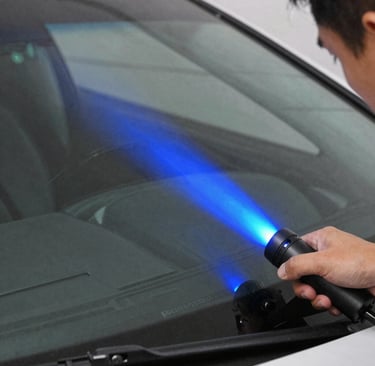
One of the biggest breakthroughs in windshield repair history was ultraviolet curing technology.
Instead of waiting hours for resin to harden naturally, technicians could now use UV light to cure repairs in minutes.
UV-cured resin offered major advantages:
Faster repairs
Stronger bonding
Improved optical clarity
Better control during installation
Reduced contamination risk
Modern windshield repair still relies heavily on UV-curing systems.
The 1990s: Windshield Repair Becomes More Scientific
By the 1990s, resin manufacturers began studying the actual physics of glass failure and crack propagation.
This era introduced the concept that windshield repair was not just cosmetic. It became understood that repairs could help restore structural performance.
Research focused on:
Tensile strength
Shear strength
Elasticity
Thermal expansion
Impact resistance
Optical refraction
Technicians learned that a successful repair required more than simply filling a chip. The resin had to behave similarly to glass under stress.
* Improved Optical Clarity
Older repairs often looked cloudy or distorted because early resin formulas had refractive indexes that differed greatly from glass.
Modern glass has a refractive index around 1.52.
As resin technology improved, manufacturers engineered formulas with refractive properties closer to laminated windshield glass. This dramatically reduced visibility of repaired damage.
At Pitstop Autoglass + Windshield Repair Service Center, we often explain to customers that no repair becomes completely invisible, but advanced modern resin can significantly improve clarity compared to older repair methods.
Vacuum and Pressure Injection Systems
The 1990s also saw improvements in windshield repair equipment itself.
Injection bridges and vacuum systems became more advanced, allowing technicians to:
Remove trapped air
Improve resin penetration
Stabilize cracks more effectively
Reduce silvering in breaks
This was important because trapped air weakens repairs and increases visibility.
The combination of better resin and better tools transformed windshield repair into a precision service.
The 2000s: High-Strength Resin Technology
As vehicles became safer and more structurally advanced, windshield performance became more important than ever.
Modern windshields contribute significantly to:
Roof crush protection
Airbag deployment support
Cabin rigidity
Passenger safety
Because of this, resin manufacturers began developing stronger and more flexible repair systems.
The Rise of Engineered Polymer Resins
By the early 2000s, many windshield repair resins were engineered at the molecular level.
Manufacturers focused on balancing several critical properties:
Strength
The resin needed enough tensile and shear strength to stabilize cracks under stress.
Flexibility
Windshields constantly expand and contract due to temperature changes. Resin that was too rigid could fail during thermal cycling.
Adhesion
Improved chemical bonding allowed resin to grip damaged glass more effectively.
UV Stability
Modern resins resist yellowing and degradation far better than older formulas.
These improvements helped increase repair longevity and customer confidence.
Environmental Factors and Resin Performance
As repair technology evolved, the industry also learned more about environmental contamination.
Today, professional technicians understand that windshield damage is highly sensitive to outside chemicals and moisture.
Contaminants can include:
Rainwater
Road oils
Dust and debris
These contaminants interfere with resin bonding and penetration.
At Pitstop Autoglass + Windshield Repair Service Center, we emphasize fast repair because fresh breaks typically repair better than older contaminated damage.
This is one reason delayed repairs often become more visible or less successful.
Modern Windshield Repair Resin Technology
Today’s windshield repair resin is vastly more advanced than the products used in the 1970s.
Modern systems use sophisticated polymer engineering designed specifically for automotive laminated glass.
Current resin technologies include:
Ultra-low viscosity crack resins
High-strength pit fillers
Fast-cure UV systems
Temperature-stable polymers
Optical-grade clarity formulas
Flexible stress-management compounds
Many premium repair systems are now designed to optimize both cosmetic appearance and structural stabilization.
The Role of Physics in Modern Windshield Repair
Modern windshield repair is deeply connected to material science and physics.
Pitstop-trained technicians must understand:
Stress distribution
Crack propagation
Thermal expansion
Surface tension
Capillary action
When a windshield flexes during driving, temperature changes, or road vibration, the repaired area experiences constant stress.
High-quality resin helps distribute these forces more evenly throughout the damaged area.
This reduces the likelihood of crack growth.
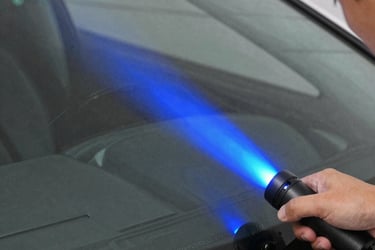
Advanced UV LED Curing Systems
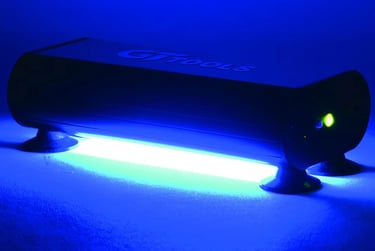
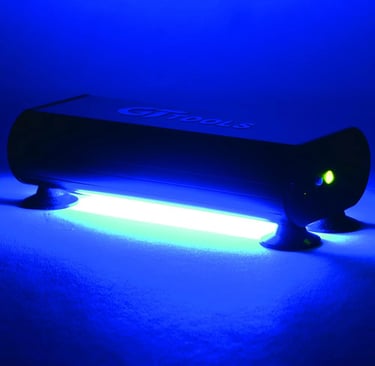
One of the newest improvements in windshield repair technology is UV LED curing.
Compared to older fluorescent UV lamps, modern LED curing systems offer:
Faster curing times
More precise wavelengths
Lower heat generation
Improved energy efficiency
More consistent curing performance
These systems help technicians achieve more predictable repair results.
Why Does Professional Windshield Repair Matter?
Even with advanced resin technology, repair quality still depends heavily on technician experience and equipment.
Professional windshield repair involves:
Proper damage evaluation
Moisture removal
Pitstop's chemical contaminant evacuation
Vacuum cycling
Pressure injection
Correct resin selection
Controlled UV curing
Surface finishing and polishing
A poorly prepped repair can leave trapped air, weak bonding, or visible distortion.
At Pitstop Autoglass + Windshield Repair Service Center of San Diego, we use professional-grade repair systems designed to maximize clarity and structural stability whenever possible.
The Future of Windshield Repair Resin
The windshield repair industry continues to evolve rapidly.
Future resin technologies may include:
Nanotechnology
Researchers are exploring nano-engineered polymers that may improve crack penetration and bonding strength.
Self-Healing Materials
Some experimental polymers can partially re-bond under stress or heat exposure.
Smart Glass Integration
As vehicles adopt more ADAS systems and smart windshield technology, repair resin may become even more specialized to preserve sensor performance.
Faster Curing Systems
Future UV curing technology may reduce repair times even further while improving durability.
Why Drivers Choose Pitstop Autoglass + Windshield Repair Service Center of San Diego:
Modern windshield repair is no longer a temporary patch. When performed correctly, it is a highly engineered process backed by decades of material science and real-world testing.
At Pitstop Autoglass + Windshield Repair Service Center, we stay current with evolving windshield repair technology so we can provide high-quality repairs that help drivers:
Save money
Preserve factory glass
Maintain structural integrity
Improve visibility
Prevent crack spreading
Our team understands the science behind windshield repair and uses professional repair systems designed for long-term performance.
Schedule Your Windshield Repair Today, San Diego!
If you have a rock chip or windshield crack, early repair gives you the best chance of saving your windshield.
Pitstop Autoglass + Windshield Repair Service Center in Carmel Mountain provides professional windshield repair services designed to restore clarity and help prevent further damage.
Contact Pitstop Autoglass today to schedule your windshield repair service and experience the modern science behind advanced windshield repair resin technology.









© 1997-2026. All rights reserved. Pitstop Autoglass + Windshield Repair Service Center® - 11905 Carmel Mountain Road, San Diego, CA 92128 | Info line: 858-675-4527 | Auto Windshield Repair San Diego, Auto Glass Repair, Best Prices, Great Service, Fast 15 Minute Windshield Repair Starting at Only $60, Carmel Mountain Windshield Repair.

Walk-in Hours: Tuesday-Friday 10a-3p, Saturday 10a-2p
Information line: 858-675-4527
NOTE: This is a recorded message line.
Fast, convenient service for Carmel Mountain, Poway, Scripps Ranch, Rancho Penasquitos, 4S Ranch, Escondido, Fairbanks Ranch and Mira Mesa residents.

