
The Physics of Rock Chips
Why Highway Speed Changes Impact Windshield Damage
SAN DIEGO WINDSHIELD REPAIRWINDSHIELD REPAIR STANDARDSWINDSHIELD REPAIR CRITICAL EDUCATIONPITSTOP AUTOGLASS WINDSHIELD REPAIR SCIENCE BLOG
Gillian R. - Pitstop Autoglass | San Diego 92128
6/28/20265 min read
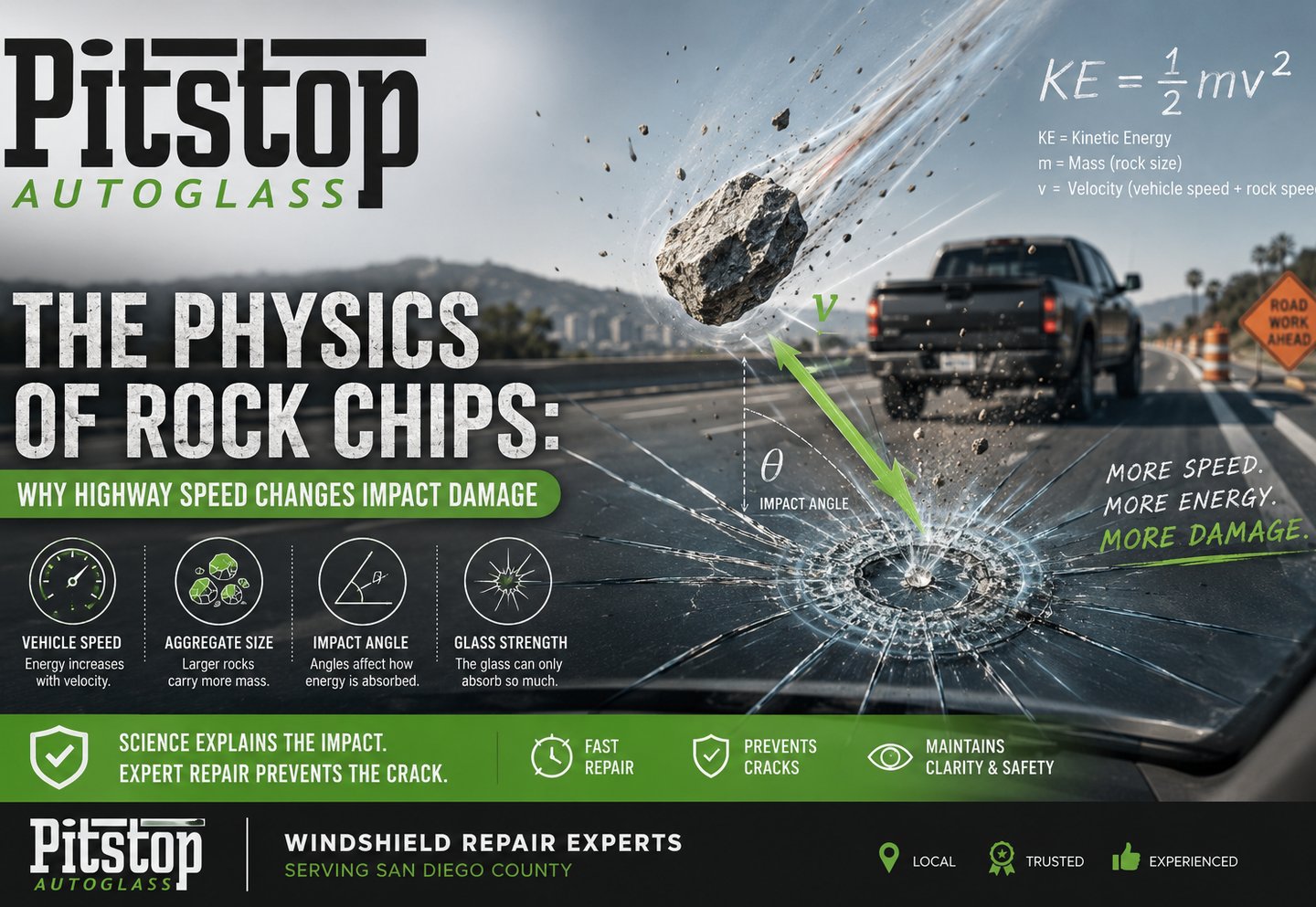
The Physics of Rock Chips: Why Highway Speed Changes Impact Windshield Damage
Keywords: rock chip windshield physics, highway windshield damage, windshield impact science, windshield repair San Diego, windshield chip repair, Pitstop Autoglass
Few drivers think about physics while cruising down Interstate 5, Interstate 15, State Route 52, or State Route 56. Yet every time a tire launches a small piece of gravel into the air, the laws of physics determine whether that rock harmlessly bounces away or leaves a permanent chip in your windshield.
Understanding the physics of rock chips can help drivers appreciate why windshield damage occurs so frequently on San Diego roads and why prompt repair is critical. At Pitstop Autoglass + Windshield Repair Service Center, we see firsthand how highway speeds, road construction, aggregate size, and impact angles combine to create windshield damage.
Let's explore the science behind windshield impacts and why your speed matters more than you might think.
Understanding Windshield Impact Science
A modern windshield is remarkably strong. It consists of two layers of glass bonded together by a plastic interlayer, creating a laminated safety structure designed to resist impacts and prevent dangerous shattering.
However, even a strong windshield has limits.
When a rock strikes the outer layer of glass, the energy of that impact becomes concentrated into a tiny area. If the force exceeds the glass's ability to flex and absorb energy, a chip, pit, bullseye, star break, or crack can form.
The severity of the damage depends on several factors:
Vehicle speed
Rock speed
Aggregate size
Impact angle
Glass condition
Temperature
Existing windshield stress
These variables all contribute to what engineers refer to as windshield impact science.
Kinetic Energy: The Main Culprit
One of the most important concepts in rock chip windshield physics is kinetic energy.
Kinetic energy is the energy possessed by a moving object and is calculated using the formula:
KE = ½mv²
Where:
KE = Kinetic Energy
m = Mass
v = Velocity
Notice something important: velocity is squared.
This means a small increase in speed creates a much larger increase in impact energy.
For example:
Relative SpeedEnergy Increase30 mphBaseline60 mph4x More Energy90 mph9x More Energy
A rock striking your windshield at a combined speed of 60 mph doesn't create twice the damage potential of a 30 mph impact—it creates approximately four times the energy.
This explains why many drivers notice windshield chips appearing during freeway driving rather than on slower city streets.
Why Highway Speeds Increase Windshield Damage
The majority of windshield chips occur on highways.
The reason is simple: relative velocity.
Imagine a truck traveling at 65 mph. A small stone becomes trapped in the tread of a tire and is suddenly ejected. Depending on tire rotation, the rock may leave the tire with considerable velocity.
Now add:
Your vehicle speed
The truck's speed
The launch velocity of the rock
The resulting impact speed can be surprisingly high.
This is why highway windshield damage is especially common on busy San Diego freeways where traffic regularly moves between 65 and 80 mph.
The faster vehicles travel, the greater the potential impact energy.
Aggregate Size Matters
Not all rocks are created equal.
Road construction materials typically contain aggregate of varying sizes. Aggregate refers to crushed stone, gravel, and other mineral materials used in paving and road maintenance.
Larger aggregate possesses more mass.
Remember the kinetic energy equation:
More mass = More energy
A tiny grain of sand traveling at highway speed may leave little more than a pit.
A larger piece of gravel can create:
Bullseye breaks
Star breaks
Combination breaks
Long cracks
Construction-grade aggregate often presents a higher risk because it contains angular fragments with sharp edges capable of concentrating force into a very small contact area.
The sharper the rock, the greater the localized stress on the glass surface.
Impact Angle: An Overlooked Factor
One of the lesser-known aspects of windshield impact science is impact angle.
Many drivers assume a rock striking head-on creates the most damage. In reality, the situation is more complicated.
The windshield itself is angled.
When a rock impacts at different angles, several things can happen:
Shallow Angle Impacts
The rock may:
Deflect off the glass
Create a surface pit
Produce minor cosmetic damage
Direct Impacts
The rock transfers more energy directly into the glass.
This can lead to:
Bullseye chips
Star breaks
Combination fractures
Angular Impacts
Certain angles can create complex stress patterns that increase the likelihood of crack formation.
The angle of the windshield, the trajectory of the rock, and vehicle speed all influence how energy is distributed through the glass.
Why Existing Damage Gets Worse
Many drivers ignore small rock chips because they appear insignificant.
Unfortunately, physics doesn't stop after the initial impact.
A windshield experiences constant stress from:
Road vibration
Vehicle flexing
Temperature changes
Wind pressure
Air conditioning and defrost systems
Every bump and temperature cycle places stress on the damaged area.
The chip acts as a stress concentrator, meaning forces become focused at the edges of the damage.
Over time, a repairable chip can become an expensive crack requiring windshield replacement.
This is why prompt windshield repair is so important.
San Diego Construction Zones and Windshield Risk
Drivers throughout San Diego regularly encounter construction zones that increase the likelihood of rock chip damage.
Areas commonly associated with roadway construction, maintenance, or resurfacing projects may include:
Interstate 5 Corridor
The I-5 corridor frequently experiences maintenance, lane improvements, and infrastructure projects. Construction vehicles and fresh paving materials can increase loose aggregate on roadways.
Interstate 15 Improvements
The I-15 corridor continues to see periodic upgrades and maintenance operations. Construction traffic often contributes to airborne debris.
State Route 52
Drivers traveling through SR-52 construction and maintenance zones frequently encounter loose gravel and road debris.
State Route 56
Ongoing roadway improvements and repairs can temporarily increase aggregate exposure.
Local Surface Streets
Many San Diego communities periodically undergo:
Asphalt resurfacing
Utility trench work
Concrete replacement
Road widening projects
Freshly laid asphalt and chip-seal surfaces often contain loose aggregate that may remain on the roadway until traffic disperses or street sweeping occurs.
How to Reduce the Risk of Windshield Damage
While no driver can completely eliminate the risk of rock chips, several strategies can help reduce exposure.
Increase Following Distance
Maintaining additional space behind trucks and construction vehicles reduces the chance of being struck by debris.
Avoid Gravel-Carrying Vehicles
Dump trucks, landscaping trucks, and construction vehicles are common sources of flying aggregate.
Slow Down in Construction Zones
Reducing speed lowers impact energy and decreases the likelihood of severe damage.
Stay Alert Near Fresh Roadwork
Recently resurfaced roads often contain loose stones that can become airborne.
Repair Chips Quickly
Small chips are generally easier and less expensive to repair than large cracks.
Why Professional Windshield Repair Works
Many people are surprised to learn that modern windshield repair is based on advanced materials science.
Professional windshield repair involves injecting specialized resin into the damaged area. The resin is designed to:
Restore structural integrity
Reduce visibility of the damage
Prevent crack propagation
Reinforce the weakened section of glass
When performed promptly, repairs can often stop damage from spreading and help preserve the original factory windshield.
At Pitstop Autoglass + Windshield Repair Service Center, our goal is to repair damage before physics has a chance to turn a small chip into a major crack.
Trust Pitstop Autoglass for Windshield Repair in San Diego
The next time a rock strikes your windshield, remember that you're witnessing a real-world demonstration of physics in action. Vehicle speed, kinetic energy, aggregate size, and impact angle all play critical roles in determining whether a windshield survives the encounter or sustains damage.
San Diego's busy highways, construction zones, and constant traffic create ideal conditions for rock chips and windshield cracks. The good news is that early repair can often prevent more costly damage down the road.
If you've recently experienced highway windshield damage, don't wait for the chip to spread. Contact Pitstop Autoglass + Windshield Repair Service Center for professional windshield repair services in San Diego. Our experienced technicians can evaluate the damage and help protect your windshield before a minor chip becomes a major problem.
Pitstop Autoglass + Windshield Repair Service Center specializes in fast, professional windshield chip repair and crack repair throughout San Diego County, helping drivers stay safe while preserving the strength and clarity of their original windshield.
© 1997-2026. All rights reserved. Pitstop Autoglass + Windshield Repair Service Center® - 11905 Carmel Mountain Road, San Diego, CA 92128 | Info line: 858-675-4527 | Auto Windshield Repair San Diego, Auto Glass Repair, Best Prices, Great Service, Fast 15 Minute Windshield Repair Starting at Only $60, Carmel Mountain Windshield Repair.

Walk-in Hours: Tuesday-Friday 10a-3p, Saturday 10a-2p
Information line: 858-675-4527
NOTE: This is a recorded message line.
Fast, convenient service for Carmel Mountain, Poway, Scripps Ranch, Rancho Penasquitos, 4S Ranch, Escondido, Fairbanks Ranch and Mira Mesa residents.

